The Busy Family Manifesto
Family life has become a logistical marathon. Busy Family exists to help.

It Often Starts With a Small Moment
It happened on a Cub Scout camping trip.
Folding chairs around a fire. Kids running through the campsite. Parents unwinding after a long day.
One of the other parents pulled me aside and said something kind.
He told me how much he loved seeing his son and my son together. They got along great. They played well together. They had the kind of friendship every parent hopes their child will find.
But then he added something else.
He said he wished our invitations to get together weren’t always so last minute.
His family planned ahead. Their calendar filled up quickly. By the time we texted to see if they wanted to hang out, they were usually already booked.
He wasn’t criticizing. He was just explaining.
But in that moment something clicked.
We weren’t just bad at managing our family calendar.
We were accidentally closing doors for our son.
The Hidden Work of Running a Family
Modern families are managing something previous generations never had to.
Logistics.
Schedules. Practices. School events. Play dates. Doctor appointments. Work meetings. Travel. Meals. Chores. Activities.
The invisible work required to keep a household running is often called the mental load.
It’s the constant background process of remembering, planning, coordinating, and anticipating everything that needs to happen to keep a family functioning.
And it’s enormous.
Research shows that in many households mothers carry about 71% of the mental load involved in running a family, including scheduling, planning activities, and organizing daily life. ([Neuroscience News][1])
This kind of cognitive labor includes things like:
- remembering school events
- planning meals
- coordinating schedules
- managing doctor appointments
- organizing activities
- anticipating problems before they happen
In other words, the logistical infrastructure of family life.
And for most families, it’s being managed with:
Group texts. Sticky notes. Half-synced calendars. Memory.
When Logistics Become Emotional

The real cost of family logistics isn’t time.
It’s stress.
When coordination breaks down, the consequences ripple through the entire household.
Plans fall through. Parents feel guilty. Kids miss out on time with friends. Partners argue about who forgot what.
The logistical burden of running a family doesn’t just consume time.
It consumes mental energy.
And often the people carrying the most of that burden are also the people trying hardest to create stability for everyone else.
Over time, that pressure turns into something many families quietly recognize:
The feeling that everyone is just barely holding it together.
The Moment Everything Became Clear
Back at that Cub Scout campout, the comment about last-minute invitations stayed with us.
But another realization followed right behind it.
Our son is on the autism spectrum.
For him, sudden changes are extremely difficult.
A spontaneous decision — something as simple as going to the store or driving to the beach — could trigger hours of distress.
At the time, it felt like we only had two choices.
Stay home and do nothing.
Or endure a multi-hour meltdown.
What we hadn’t realized was that there was a third option.
Plan ahead.
Give him time to prepare. Create a social story. Let him understand what was coming.
The problem wasn’t our son.
The problem was our calendar.
The Modern Family Coordination Problem
Here’s something strange about modern life.
At work, we have extraordinary tools to manage complexity.
Project managers. Dashboards. Automations. Reminders. Assistants. AI.
Entire industries exist to help organizations coordinate people, schedules, and responsibilities.
But at home?
The logistical complexity of family life is often even greater.
And most families manage it with tools that barely talk to each other.
Family coordination is one of the hardest operational problems most people will ever run.
And almost no technology is designed to truly help.
The Mission Behind Busy Family
Busy Family exists because families deserve support too.
Our mission is simple:
Help families meet their non-negotiable commitments.
School pickups. Practices. Doctor visits. Friendships. Family time.
These are the moments that shape childhood.
And when the logistical burden of managing them becomes overwhelming, something important gets lost.
Connection.
Busy Family is being built to reduce the cognitive load of family life.
Not to make families more productive.
But to make family life less stressful.
To give parents back mental space.
To help kids spend more time with friends.
To create room for the moments that actually matter.
Yes, Busy Family Uses AI
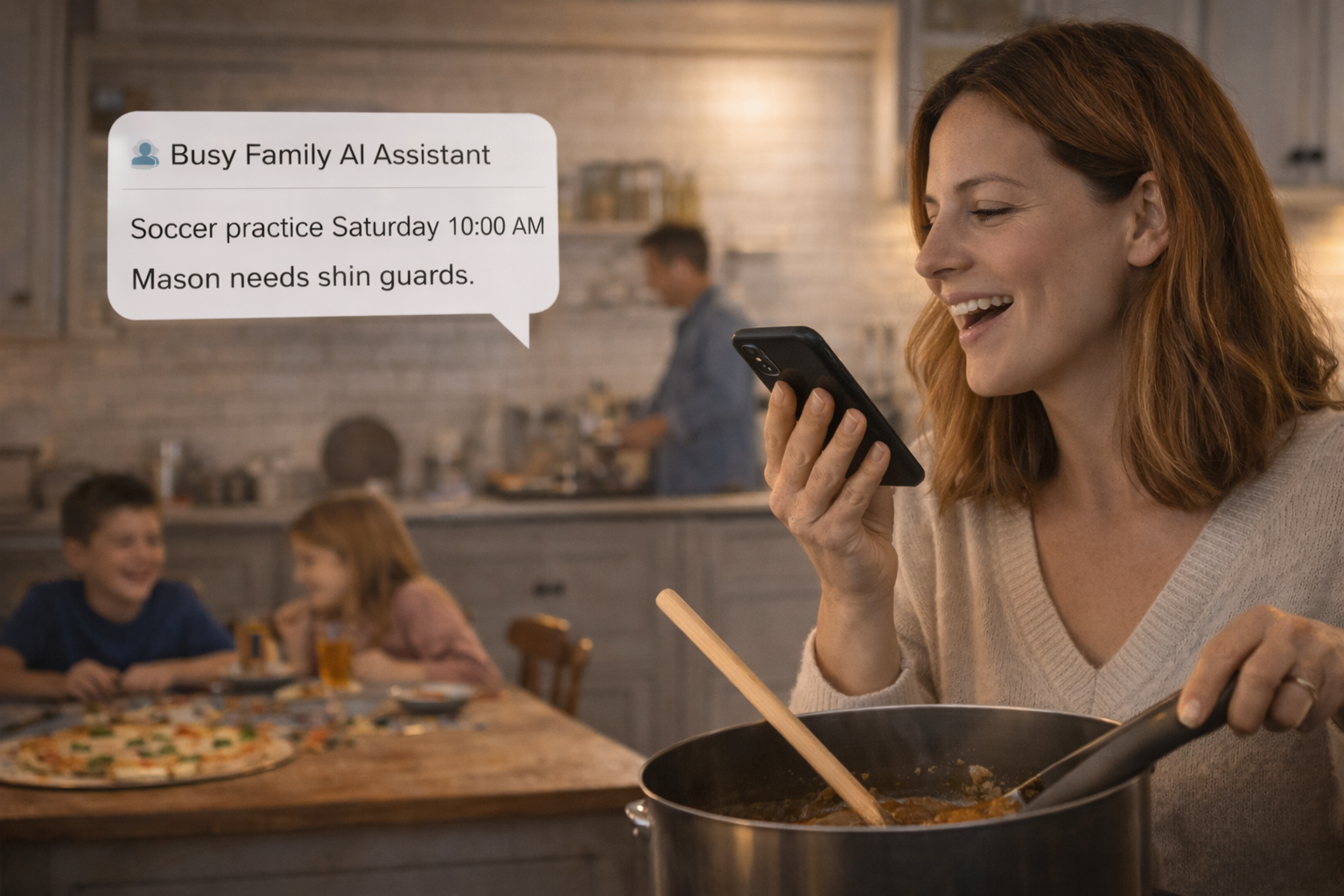
But Busy Family is not about AI.
It’s about families.
AI is simply a tool.
A powerful one.
It allows software to understand schedules, coordinate information, and assist families in ways that were not possible before.
But the technology is not the point.
The point is the parent trying to remember five different pickup times.
The child who needs predictability.
The partner trying to balance work and family.
Busy Family exists in service of them.
This Is Just the Beginning
We want to be honest about something.
Busy Family does not yet fully solve this problem.
The logistical challenges families face are enormous.
And building the technology to truly support families will take time.
But our mission is clear.
Every feature we build. Every decision we make. Every line of code we write.
Is guided by a single question:
Does this reduce stress for families?
If the answer is yes, we keep building.
Because Childhood Doesn’t Wait

We still think about that Cub Scout camping trip.
A simple comment from another parent revealed something we hadn’t fully seen.
Our family calendar wasn’t just disorganized.
It was shaping our son’s world.
It was shaping the friendships he could have. The experiences he could prepare for. The moments he could participate in.
And once we saw that clearly, it became impossible to ignore.
Because childhood doesn’t wait.
Friendships don’t pause while we figure out our calendars.
Family life happens in real time.
And the logistical burden of managing it shouldn’t fall entirely on exhausted parents trying to hold everything together.
That’s why Busy Family exists.
Not to make families more efficient.
Not to optimize childhood.
But to help families spend less time coordinating life and more time living it.
And we are only at the beginning.
The logistical challenges of family life are enormous.
Solving them will take years of work, learning, and listening to the families who trust us enough to use what we’re building.
But the direction is clear.
Every feature we build. Every improvement we make. Every idea we explore.
Is guided by a simple belief:
Families deserve better support.
And the work of building that support has only just begun.